
Free resources to help you plan
Free tools and expert guides to help you understand planning rules, project costs, and timelines before starting your extension.
Planning Feasibility Checker
– Check if your extension requires planning
– Answer a few quick questions about your property
Best for: quickly checking if you need planning permission
Build Estimator
– Estimate total build cost of your extension
– Includes design fees and construction costs
Best for: understanding the likely cost of your project
Articles & Guides
– Planning permission explained
– Permitted development rules
Best for: learning about planning rules and costs
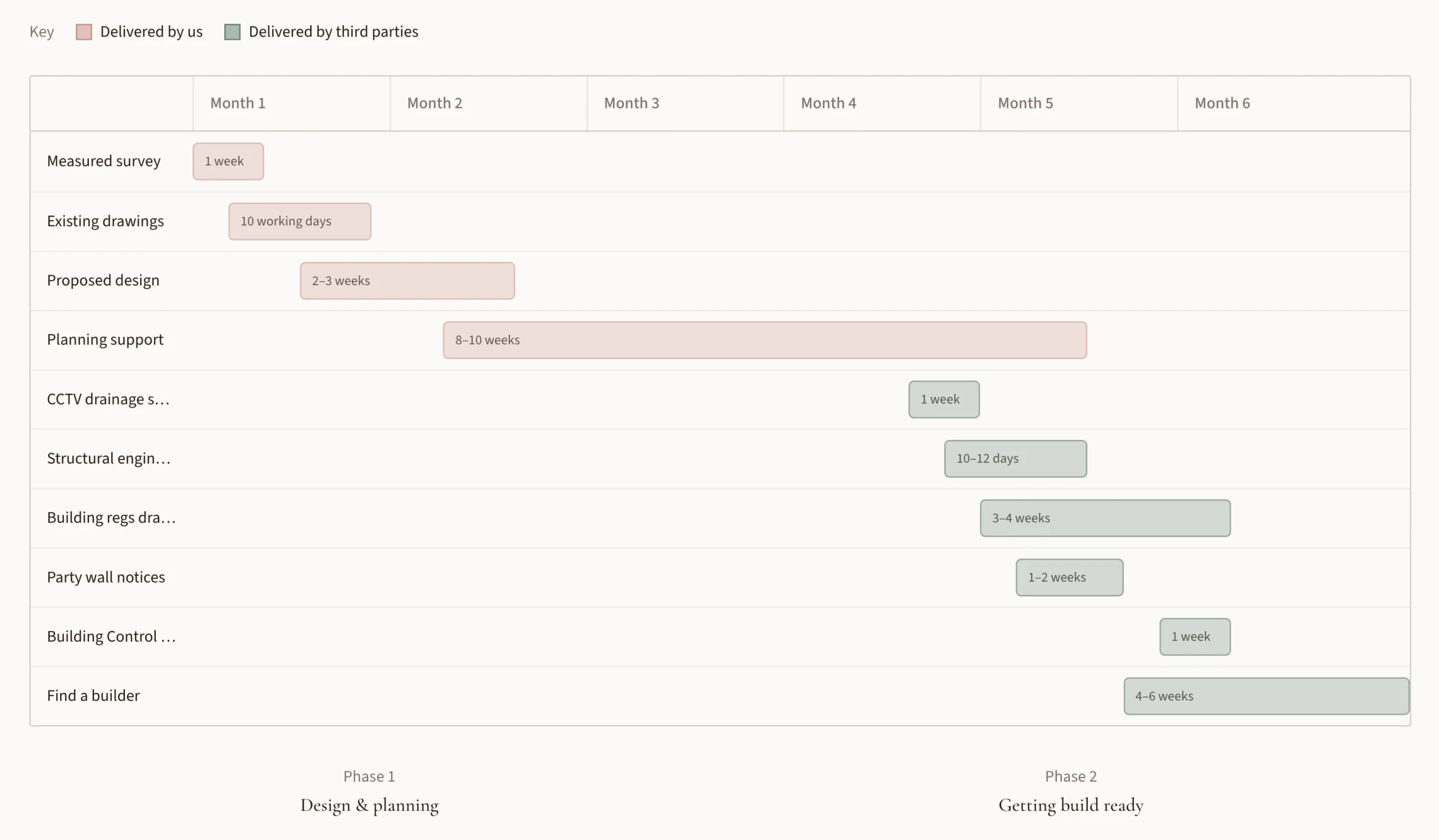
Programme guide
An indicative timeline for a typical extension project. Timeframes rely on you taking action promptly when needed.
1.Survey & existing
1 week
2.Proposed design
2-3 weeks
3.Planning application
8-10 weeks
4.Building regs drawings
4 weeks
5.Third parties
Various
6.Find a builder
4–6 weeks
Frequently asked questions
Common questions about our drawing packages, planning process.
1. What is a planning application?
A planning application is the formal process of asking your local authority for permission to carry out certain types of building work or development. For homeowners, this usually means establishing whether your proposal can proceed under permitted development rights or whether it requires a householder planning application.
In simple terms, it is the stage where your ideas are tested against planning rules, site constraints, and the character of the surrounding area. It gives you clarity on what is likely to be accepted before you move further into detailed design and construction.
If you are still at an early stage and not yet sure what is possible, the best place to begin is with a feasibility review. That allows us to assess your property, your brief, and the planning route most suitable for your project before unnecessary time or money is spent.
2. What is the difference between permitted development and a householder planning application?
The main difference is that permitted development follows a defined set of rules, whereas a householder planning application is assessed by the council on its planning merits. In many cases, an extension can proceed without a full planning application if it stays within the relevant limits and conditions set out under permitted development rights. If it goes beyond those limits, householder planning permission is usually required.
Permitted development can be a smoother route when the proposal clearly meets the criteria. Those criteria typically relate to matters such as scale, depth, height, position, and relationship to boundaries. In England, the idea of a strict “volume” limit is more relevant to some loft-related scenarios than to most standard rear and side extensions, so it is usually more accurate to think in terms of measured limits and conditions rather than volume alone.
A householder planning application offers more design flexibility, but it also involves a fuller assessment by the local authority. That assessment may consider design quality, impact on neighbours, the street scene, and the wider context of the property
3. Why do homeowners choose us?
Homeowners come to us because they want more than drawings alone. They want a process that brings together planning clarity, thoughtful design, and confidence in what comes next.
We help clients make informed decisions from the outset—whether that means understanding what is likely to be approved, refining a brief, or shaping an extension that feels both beautiful and well judged. Our approach is design-led, but grounded in the realities of planning and buildability.
4. How do Planningbys2b differ ?
We started Planning by S2B to offer a more thoughtful and creativity route—one that bringstogether planning understanding, design-conscious route from the beginning. Whether the aim is to extend for more space or to create a new home from the ground up, we believe well-designed space should feel achievable, not confusing or inaccessible.
Larger platforms can be efficient, but many clients are looking for something more tailored: apractice that understands the planning process, pays attention to the character of the home and material, and helps shape a proposal with care rather than treating it as a standardised package with standard finishes.
Most homeowners renovate only once or twice in a lifetime. It is a major decision, and the early stages can shape everything that follows. We understand getting the space well-thought through, inform thefoundation for how your home will eventually look, feel, and function. Our role is to help you navigate planning intelligently while designing a scheme that is genuinely worth building.
5. What is included in your planning application service?
Our planning application service for extension projects typically includes the measured survey, architectural drawings, and the architectural document required to support a planning submission.
This stage is focused on developing a clear proposal, presenting it properly, and preparing the information needed for submission. For many homeowner extension projects, that will cover the core architectural package needed to move through planning with confidence.
In some cases, additional third-party reports may also be required depending on the site and the complexity of the proposal. This is more common for projects in conservation areas, sensitive settings, or for entirely new-build homes, where planning requirements are often more extensive.
6. How long does the planning process take?
For a typical householder application, the council’s decision period is often around 8 weeks non-conservation area, although the full process can take longer once design development, review, submission, and any council queries are taken into account.
Permitted development can sometimes be quicker where the proposal clearly fits within the rules, although many homeowners would be recommended to obtain formal confirmation on their PD through a lawful development certificate for certainty before building to prevent any enforcement on starting work.
A householder planning application allows the project to be assessed as a complete design proposal, rather than being limited by the fixed rules of permitted development. This can give homeowners more flexibility to combine a loft conversion and extension within one scheme, with greater opportunity in exploring the scale, layout, form, and material choice of the design.
7. Construction budget for the build?
Construction costs depend on several factors, including the complexity of the design, the quality of materials, the level of finish, and the location of the project. At the early stages, budget figures are usually indicative rather than exact, as the project is still being developed and important details—such as the level of specification, material selections, glazing, and technical requirements—are not yet fully refined.
Planning-stage drawings can help establish a broad construction budget, but a more reliable cost picture usually emerges later, once the project reaches the technical design stage. The RIBA Plan of Work places technical design after the concept and planning stages, before construction begins.
8. How do I get started?
The best place to begin is with a feasibility review or an initial consultation. This allows us to understand your property, your aims, and whether the project is likely to follow a permitted development route or require a householder planning application.
Once the scope is agreed, we arrange the measured survey and begin developing the design with you. From there, we prepare the drawings, review the scheme together, and refine it before submission. Our aim is to assist home-owners to navigate the planning process with confidence and clarity
9. Do I need building regulations after planning permission?
Building regulations are a separate stage from planning. While planning considers whether the proposal is acceptable in principle, building regulations are concerned with how it is designed and constructed so that it is safe, compliant, and suitable to build.
Building regulations cover matters such as structural integrity, fire safety, insulation, damp-proofing, foundations, ventilation, heating, and accessibility. This stage ensures that the project meets the national standards required to protect health, safety, and performance within the building.
Once planning permission has been granted, building regulations drawings will typically need to be prepared and approved before construction begins. It is an essential part of moving a project from an approved idea into something that can be properly built.
It is also worth noting that carrying out work without the correct approvals can create serious issues later. Local authorities have powers under the Building Act 1984 to take action where building work does not comply, so it is always worth getting this stage properly resolved.
10. What happens after planning?
Planning is usually the stage that brings clarity to the overall direction of the project. It helps homeowners understand what is achievable and allows the proposal to be visualised through drawings and, where relevant, 3D design work.
After planning, the project typically moves into the more detailed stages of delivery. Depending on the project, this may include structural engineering, building regulations drawings, MEP coordination, party wall matters, tendering, and appointing a builder. Under the RIBA Plan of Work, this broadly sits after the concept and spatial coordination stages, moving into technical design and then construction.
In other words, the concept and planning stages set the vision in place. The detailed stages that follow provide the information needed for the building process to be properly coordinated and delivered well.